
Blog
When a Furniture Appraisal for Estate Taxes and Probate Is Legally Required
A furniture appraisal for estate tax and probate filings is legally required once household items cross specific IRS and court thresholds, not just whenever an executor feels uncertain. This guide explains when a casual value check is fine and when only a qualified, documented appraisal will hold up to scrutiny.
Settling an estate almost always means someone has to figure out what the furniture is worth. The question that trips up most executors and heirs isn't how to guess a number. It's whether a guess is even legally acceptable, or whether the IRS or a probate court expects something more formal.
The short answer: it depends on value and jurisdiction. Federal estate tax filings have a specific dollar trigger for a qualified appraisal. Probate courts vary by state and often lean on the same fair-market-value concept without mandating a sworn report. Getting this distinction wrong either wastes money on an appraisal nobody required, or exposes the estate to an audit with nothing but a guess to defend it.
When Does an Estate Legally Require a Furniture Appraisal?
For federal estate tax purposes, a formal appraisal becomes mandatory once household and personal effects with marked artistic or intrinsic value total more than $3,000, whether that's a single piece or a collection reported together. IRS guidance on estate property valuation confirms that estates must report household effects at fair market value as of the date of death, and that crossing this threshold triggers the requirement to file an expert appraisal with the estate's federal tax return.
Below that $3,000 line, executors generally have more flexibility. A reasonable, documented estimate for ordinary furniture, appliances, and household goods is typically sufficient. Above it, the IRS expects a report prepared by someone qualified to render that opinion, not a family member's best guess or a printout from an online marketplace.
This threshold applies per item or per collection of similar items, not to the estate as a whole. An estate with a $40,000 dining set and a garage full of ordinary furniture worth $8,000 combined may only need a formal appraisal for the dining set, while the rest gets reported using simpler documentation.
Key takeaway: the $3,000 threshold is about specific items or groups of similar items with real value, not the estate's total worth. Most household furniture never approaches it; the antiques, fine pieces, and sets that do are exactly where a formal report earns its cost.
Our furniture appraisal service is built around this distinction. We help executors sort out which pieces genuinely require a qualified opinion of value and which can be handled with lighter documentation, so the estate isn't paying for more appraisal work than the filing actually needs.
What Counts as Fair Market Value Under Federal Estate Tax Rules?
Fair market value for estate tax purposes is the price a willing buyer would pay a willing seller, with neither party under any compulsion to buy or sell and both having reasonable knowledge of the relevant facts. This standard, set out in the Treasury regulation governing household and personal effects, is deliberately different from insurance replacement cost or what a family member paid for a piece originally.
That distinction matters more than most executors realize. A dining room set insured for $15,000 in replacement value might have a fair market value closer to $4,000 once you account for what similar sets actually sell for in the secondhand and antiques market. The IRS wants the second number, valued as of the decedent's date of death, not the day the estate gets around to filing.
Example: An estate includes a mahogany bedroom suite the family insured for $12,000. A qualified appraiser researches recent auction and dealer sales of comparable suites and concludes a fair market value of $3,400 as of the date of death. That $3,400 figure, not the insurance number, is what goes on the estate tax return.
Room-by-Room Itemization and the $100 Grouping Rule
Federal estate tax reporting for household goods generally follows a room-by-room itemization convention. Rather than listing every lamp and end table separately, appraisers document contents by room and describe the notable pieces individually, grouping ordinary, low-value miscellany together.
A common industry practice allows items of similar type valued under roughly $100 each to be grouped into a single lot figure rather than itemized piece by piece. This keeps the inventory manageable for estates full of ordinary household goods while still isolating higher-value furniture, art, and antiques for individual description and valuation.
Watch out: grouping is meant for genuinely low-value items, not as a shortcut around appraising a valuable piece. An executor who lumps an unrecognized antique sideboard into a "miscellaneous furniture" group risks understating the estate's value, which creates exposure if the return is ever examined.
How Do Probate Court Filings Differ from IRS Estate Tax Filings?
Probate courts operate under state law, and most states do not impose a formal appraisal requirement the way federal estate tax rules do at the $3,000 threshold. Instead, probate typically requires the executor or personal representative to file an inventory of estate assets with a good-faith estimate of value, and courts generally expect that estimate to reflect open-market value rather than replacement cost or sentimental worth, echoing the same fair-market-value logic used at the federal level.
The practical gap is enforcement. Probate courts rarely audit furniture values the way the IRS can audit an estate tax return, but they can still demand documentation if an heir contests the inventory or if the estate's total value affects court fees, bond requirements, or creditor claims. An unsupported number that goes unchallenged in probate can still cause problems later if a beneficiary disputes the distribution.
Pro tip: even when your state doesn't require a formal appraisal for probate, filing one for high-value furniture protects the executor personally. If an heir later claims the estate undervalued a piece, a documented appraisal is the executor's best defense against a breach-of-duty claim.
DIY Value Check vs Formal Furniture Appraisal: What's the Difference?
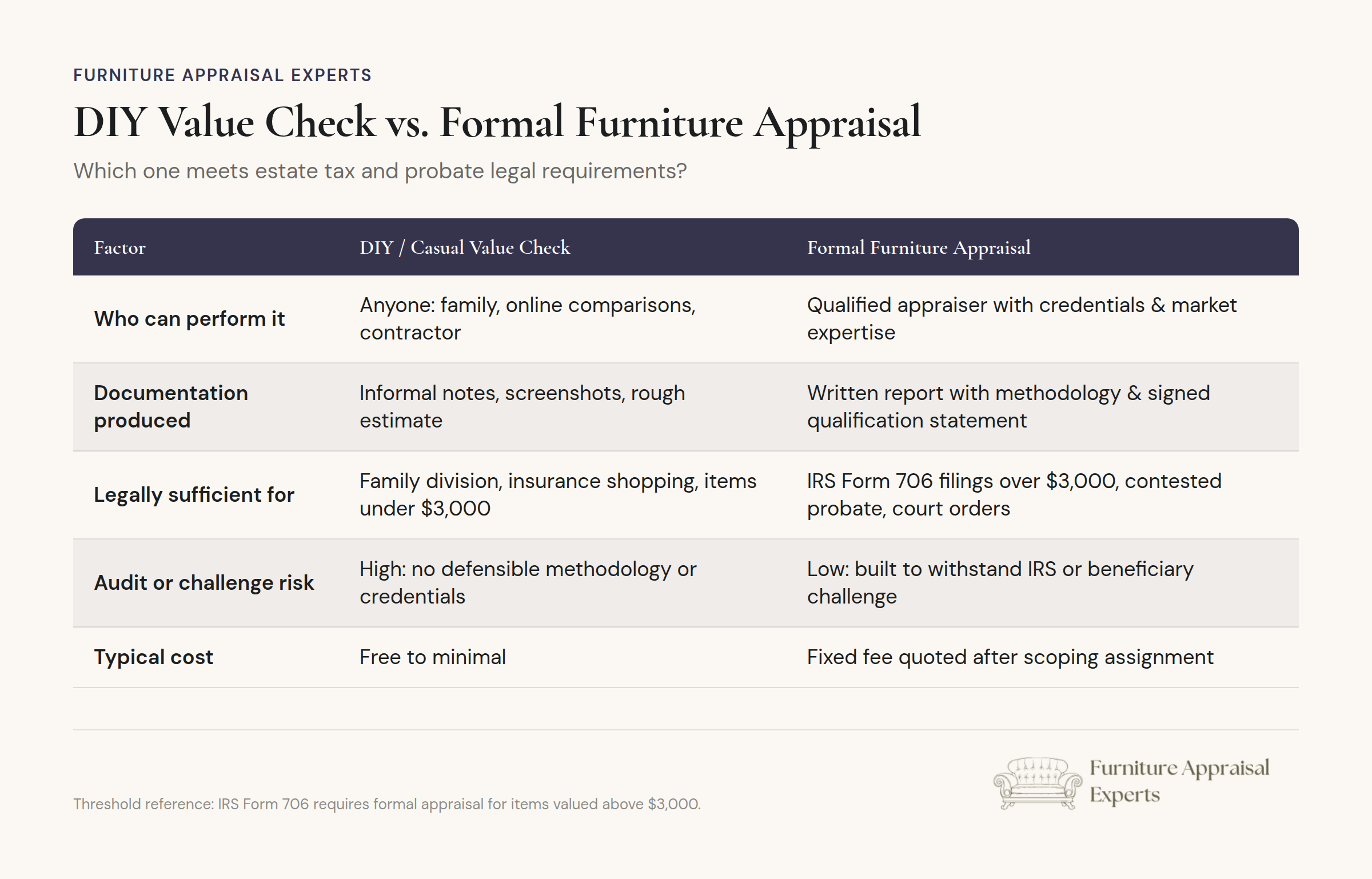
A quick online value check and a formal furniture appraisal for estate or probate purposes look similar on the surface but serve very different legal functions. The table below breaks down where each one is actually sufficient.
| Factor | DIY / Casual Value Check | Formal Furniture Appraisal |
|---|---|---|
| Who can perform it | Anyone: family member, online listing comparison, general contractor | A qualified appraiser with relevant credentials and market expertise |
| Documentation produced | Informal notes, screenshots, or a rough estimate | Written report with descriptions, valuation methodology, and a signed qualification statement |
| Legally sufficient for | Family division, insurance shopping, general curiosity, low-value items under the $3,000 threshold | IRS Form 706 filings above $3,000, contested probate inventories, court-ordered valuations |
| Audit or challenge risk | High: no standing methodology or credentials to defend the number | Low: prepared to withstand IRS review or challenge by an heir or beneficiary |
| Typical cost | Free to minimal | Quoted as a fixed fee after scoping the assignment |
A casual check works fine when the goal is dividing grandma's furniture fairly among siblings or deciding what to insure a set for. It falls apart the moment a return gets filed or a beneficiary disputes a number, because there's no qualification statement behind it and no defensible methodology if questioned.
What Must a Qualified Appraiser's Statement Include?
A formal appraisal filed with an estate tax return needs more than a dollar figure. It needs a signed statement identifying the appraiser's qualifications, the basis and methodology used to reach the value, a description of each item's condition and provenance where relevant, and confirmation that the value reflects fair market value as of the date of death rather than replacement cost or original purchase price.
Appraisers working in personal property typically hold credentials from organizations such as the International Society of Appraisers, the American Society of Appraisers, or the Appraisers Association of America, and prepare reports in accordance with the Uniform Standards of Professional Appraisal Practice set by The Appraisal Foundation. That standards framework is what gives an estate tax filing or a contested probate inventory something concrete to point to if the value is ever questioned.
Our how furniture appraisal works guide walks through the full process in more detail, including what an appraiser needs from the executor before the site visit or photo review even starts. For complex, multi-room estates that need detailed itemization across an entire household, on-site personal property appraisal engagements are quoted as a fixed fee after scoping and, for the most complex estates, can run into the $1,600 to $3,500-plus range depending on the number of rooms, item count, and depth of research required.
Protect the Estate Before You File
The legal line is narrower than most executors expect. Below $3,000 in marked-value household items, a reasonable estimate usually holds up fine, whether for probate or a modest estate tax return. Above it, or whenever an heir contests the inventory, only a documented appraisal with a qualified appraiser's statement gives the estate something defensible.
When in doubt, it costs far less to get a professional opinion upfront than to defend an unsupported number to the IRS or a probate judge later. If your estate includes furniture, antiques, or a full household that needs sorting out before a filing deadline, our team can scope the assignment and quote a fixed fee before any work begins. See how Furniture Appraisal Experts approaches estate and probate work, or check answers to common valuation questions.
This article is provided for general informational purposes only and does not constitute legal, tax, or financial advice. Readers should consult a qualified attorney or CPA regarding their specific circumstances.